
- Milling for prismatic parts; turning for round parts; mill-turn for both in one clamp; grinding only where tolerance demands. ±0.003 mm milling / ±0.002 mm turning; ±0.002 mm grinding.
- 100+ machines under one roof keeps parts from leaving the building between operations.
What does each CNC service actually cost you per part?
Cost per part follows machine time plus setup. A lathe removes material fast on a rotating workpiece, so turning is the cheapest way to make a round part. Milling is the cheapest way to make a flat, pocketed part. The moment a part needs both turned and milled features, a mill-turn center beats a lathe-plus-mill handoff because it removes a setup and a queue. The table orders services by the geometry they serve cheapest.
The second half of the cost equation is the material. Each process has a material it cuts best — turning favors free-machining brass and aluminum, milling favors stable aluminum and mild steel, and grinding favors hardened steel that has already been heat-treated. The same geometry priced for a different alloy lands on a different process, which is why material and process are one decision, not two.
| Service | Best for | Held tolerance | Cost logic |
|---|---|---|---|
| CNC turning | Shafts, pins, bushings, spacers | ±0.002 mm | Fastest metal removal on round stock |
| 3-axis milling | Housings, plates, brackets | ±0.003 mm | Prismatic parts in few clamps |
| 5-axis milling | Angled or contoured faces | ±0.003 mm (milling) / ±0.002 mm (turning) | One clamp removes stack-up error |
| Mill-turn | Turned + milled features | ±0.003 mm (milling) / ±0.002 mm (turning) | No handoff between lathe and mill |
| Precision grinding | Bearing seats, tight roundness | ±0.002 mm | Finishing pass only where needed |
How do you pick the cheapest service for a round part?
If the part is rotationally symmetric — a shaft, pin, bushing, or spacer — turning is almost always the cheapest route because the workpiece rotates and the tool does the cutting in one continuous pass. Grinding enters only when a journal or seat needs a tighter roundness than turning can hold, and even then it is a finishing pass on top of turning, not a replacement. Adding grinding where turning already meets the print is paying twice for the same dimension.
Turning capacity matters at both ends of the size range. The lathes here run up to Ø720 × 1280 mm, which covers most round work without a premium setup, and Swiss-type machines handle small, slender shafts on the other end — a part too thin to turn rigidly on a conventional lathe. The size envelope you need is part of the routing decision, because a part that barely fits a machine costs more than one that fits it comfortably.
How do you pick the cheapest service for a prismatic part?
Flat, pocketed, or stepped parts go to milling. Start with 3-axis and only escalate to 4-axis or 5-axis when the geometry demands angled or contoured faces that would otherwise need multiple re-clamps, because every re-clamp adds setup time and stack-up error. A shop that has 3-axis, 4-axis, and 5-axis centers can route the part to the lowest axis count that still holds the geometry, which is the whole point of cost-driven selection.
Axis count is a rate decision, not a quality decision. A 5-axis center books at a higher hourly rate, but on a genuinely contoured part it removes the re-clamps that a 3-axis path would need, so the higher rate can produce a lower total. The honest shop routes to the lowest axis count that holds the geometry in one or two clamps, and tells you why. The lazy shop defaults everything to the most expensive machine and bills you the difference.
When does mill-turn beat a lathe and a mill separately?

When a part needs both turned and milled features, running it on a mill-turn center removes the handoff between two machines. That saves a setup, a queue, and the risk of a tolerance drifting between operations — all of which show up as cost. The mill-turn centers here are Mazak and Brother class multi-task machines, holding ±0.003 mm (milling) / ±0.002 mm (turning) in a single clamping.
The datum is the hidden saving. When a part moves from a lathe to a mill, the two operations reference different datums, and any mismatch becomes stack-up error on the finished part. A mill-turn center keeps one datum through both operations, so the turned and milled features are true to each other by construction, not by luck. For a part where a cross-hole must sit on a turned diameter, that single datum is worth the mill-turn rate by itself.
When does grinding pay for itself?
Grinding pays when the print calls out a bearing seat, a press-fit diameter, or a roundness that turning cannot hold. The tolerance is ±0.002 mm, and the cost is justified by the function — a seat that is out of round will fail in service, which costs far more than the grinding pass. The rule is simple: grind only what the function demands, and leave the rest at the turning or milling band.
Grinding is also the correction for heat treatment. When a part is hardened, the treatment distorts it slightly, and the surfaces that matter are ground back to size afterward. That sequence — turn, harden, grind — is the standard path for journals and seats on heat-treated shafts. The grinding pass is not an upgrade to the turning; it is the step that makes the hardened part dimensionally correct.
Why does keeping services under one roof lower your total?
Every time a part moves between vendors for a different operation, you pay a markup and absorb a schedule risk. When milling, turning, mill-turn, and grinding all run on one 6,800 m² floor, the part moves between machines, not between companies — one accountable supplier, one flow, one invoice. That consolidation is a real cost saving, not a convenience.
The schedule risk is the part buyers undercount. A part routed through two shops has two queues, two lead times, and a handoff where neither shop is accountable for the gap. A part that runs end to end on one floor has one queue and one owner for the whole flow. When a delivery slips, you have one party to call instead of two parties pointing at each other, and that call is faster and cheaper to make.
How do you ask for a service quote that comes back real?
Send a 3D STEP or IGES file plus a 2D PDF with tolerances on the critical features only, and state the material grade and finish in the same message. That lets the shop route your part to the cheapest process that holds the geometry and return a real number instead of a range.
The process question belongs in the request. Ask which process family the part lands on and why, and the answer tells you whether the shop read the drawing. A quote that names turning, milling, or mill-turn — and the axis count — is a plan. A quote that names nothing is a rate card with your part number on it.
How do you know a shop matched the service to your geometry?
A quote that names the process — and why — is the difference between a shop that thought about your part and one that priced a rate card. Ask which machine family the part lands on and why that family is the cheapest fit. If the answer is "whatever is open," the routing is quietly costing you money.
- Which service, and why? The quote should name turning, milling, or mill-turn and the reason it matches your shape.
- How many setups? Fewer clamps means less stack-up error and less machine time billed.
- Is grinding a separate line? It should appear only if a journal or seat demands it, not as a default pass.
- What axis count? The part should route to the lowest axis count that still holds the geometry.
How does material machinability change the process cost?
The same process charges a different effective rate per material, because the material decides how fast the tool can cut and how often it must be changed. Free-machining brass turns at high speed with a clean chip and long tool life, so its machine-time cost is low. A titanium alloy runs slow, generates heat, and dulls inserts quickly, so the same machine hour produces fewer parts. The process is the same; the output per hour is not.
| Material family | Machinability | Effect on process cost |
|---|---|---|
| Brass (C360) | Excellent | Fastest cuts, longest tool life, lowest time cost |
| Aluminum (6061) | Excellent | Fast, stable, cheap per part |
| Carbon steel (12L14) | Very good | Free-machining, clean chip |
| Stainless (303, 304) | Moderate | Slower feeds, work-hardening risk |
| Alloy steel (4140) | Moderate to low | Slower when hardened, more tool wear |
| Titanium (TC4) | Low | Slow, hot, hard on tools — reserve for function |
What does it cost to switch a part between processes?
Every process switch is a handoff, and a handoff carries three costs: a new setup, a new queue, and a new chance for tolerance to drift. A part that is turned and then milled on separate machines pays all three. A part that runs on a mill-turn center pays none of them. The question is not whether a second process is ever needed — it is whether the part's geometry earns the switch or suffers it.
The drift is the cost that hides. When a part moves between machines, the datum is re-established, and a small error in re-establishing it becomes a feature that is out of position on the finished part. That error shows up at inspection, not at the machine, which is why a multi-process part costs more to inspect as well as more to machine. Keeping the part on one machine keeps the datum — and the inspection burden — under control.
What this shop actually runs
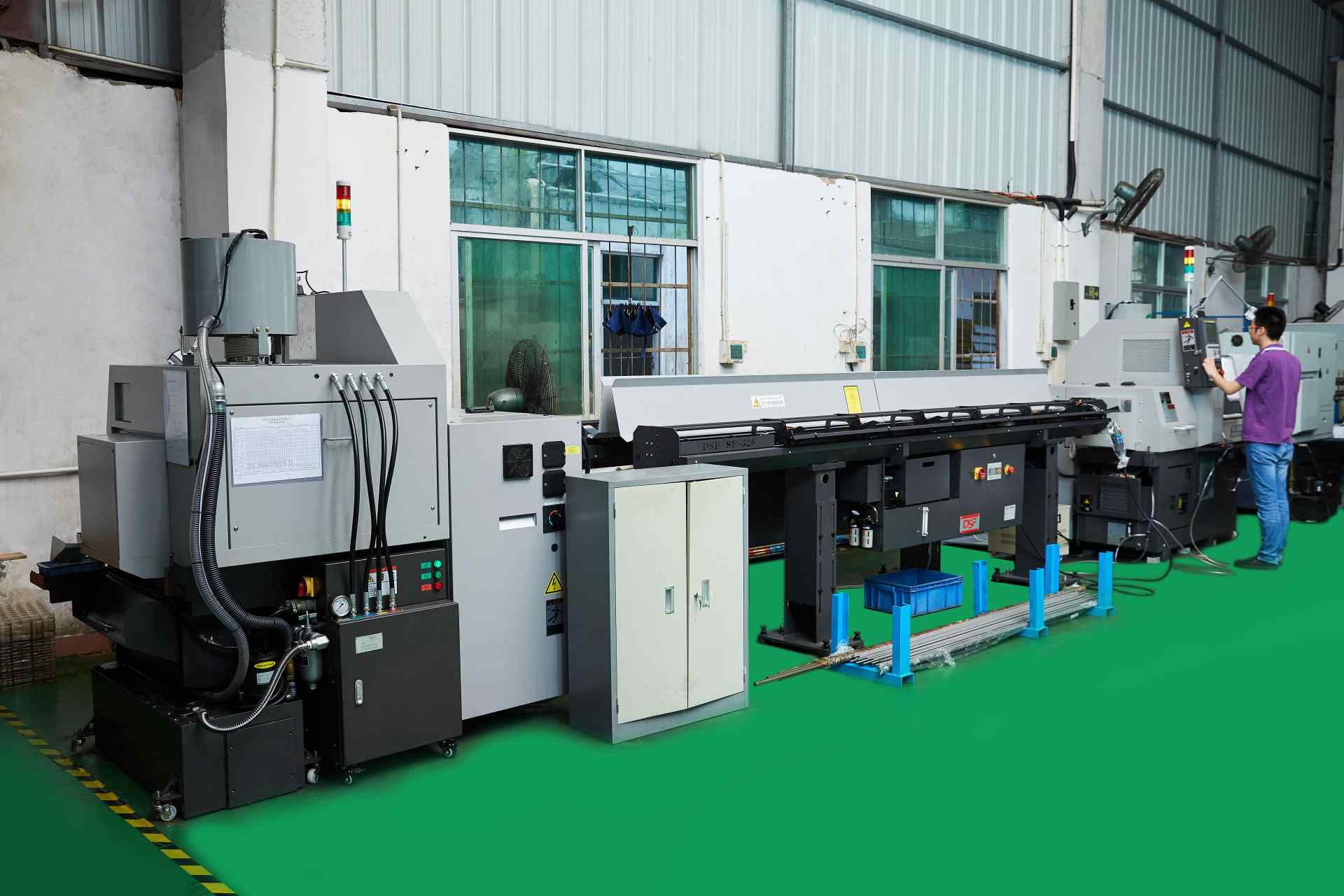
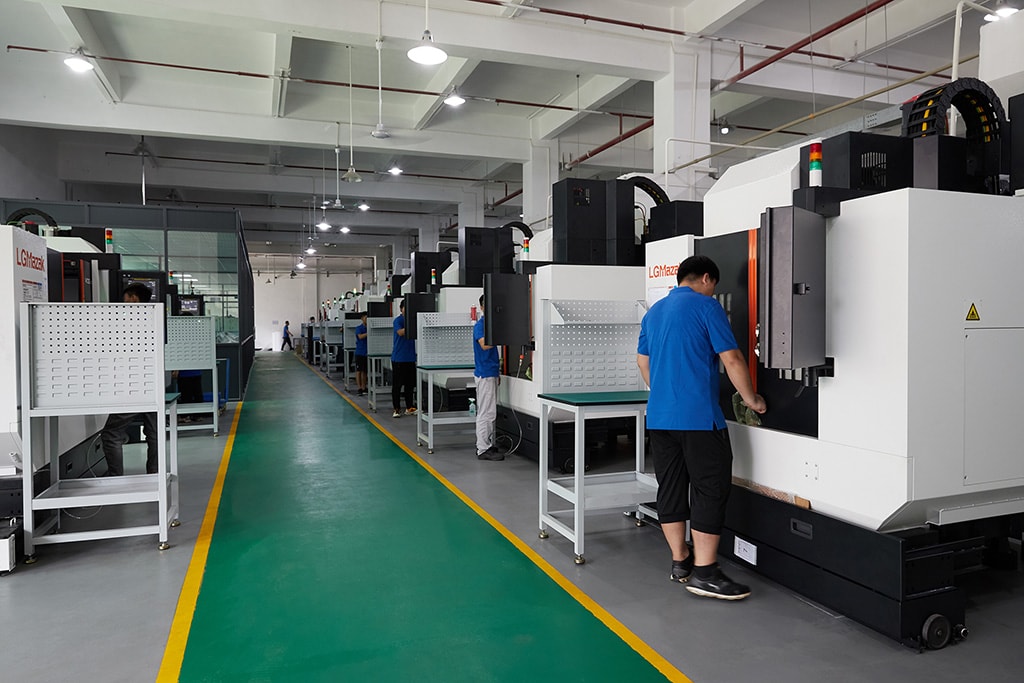
If you ask for capability evidence, you deserve a specific answer. This facility operates 100+ CNC machines across 6,800 m2 in Dongguan, China, staffed by 100+ people. The machines, listed by category:
- 5-axis machining centres (10+) - Mazak VARIAXIS I-600 (510/910/510 mm travel, 12,000 rpm, 22 kW, 71.6 N·m, 30-tool BT40) and Mazak INTEGREX I-250H S (B-axis 0.0001°, 24 kW, 124 N·m, 38-tool HSK-A63). Used on compound-angle parts, single-setup multi-face prismatic work, and aerospace fittings where datum transfer loss is unacceptable.
- 3-axis / 4-axis machining centres (50+) - Brother SPEEDIO S500Z2N / S700Z2N (10,000 rpm, 14/21-tool ATC, 0.7 s tool-to-tool, Z-axis 2.2 G) and Mazak VCE-430A L / VCE-570C L (10,000 rpm, 118 N·m, 24-tool ATC). Used on prismatic parts, plates, brackets, housings.
- Swiss-type turning centres (10+) - Citizen Cincom A20-3F7 (Φ20 mm, 10,000 rpm), TSUGAMI B0206-III / B0205-III (Φ20 mm, 0.1 µm), STAR SR-32JII / SR-32J Type N (Φ32 mm, 8,000 rpm). Used on long, slender rotational parts at ±0.002 mm.
- CNC turning centres (20+) - HEADMAN T70M/1250 (720 mm swing, 117 mm bore, 3,000 rpm, BMT75 12-station turret). Used on shafts, bushings, flanges up to ±0.002 mm.
- Wire EDM (5+) - Sodick AQ535L (550/350/300 mm travel, ±20° taper, 800 kg workpiece). Used on hardened tool steel, internal splines, sharp internal corners that milling cannot reach.
- Inspection: Hexagon CMM + 20+ gauges - Hexagon CMM for coordinate measurement, plus vision system, profilometer, hardness tester, coating thickness gauge, XRF for material verification. The 10:1 rule (gauge 10x more accurate than the band) is applied to every feature.
- Machine highlights - VARIAXIS I-600: one-setup multi-face 5-axis + MAZA-CHECK auto-calibration; INTEGREX I-250H S: DONE-IN-ONE mill-turn, B-axis 0.0001° + Ai thermal shield; SPEEDIO S500Z2N / S700Z2N: Z-axis 2.2 G + 0.7 s ATC; Swiss-type: guide-bush switchable + 0.1 µm resolution.
Tolerance bands: ±0.003 mm milled, ±0.002 mm turned, ±0.002 mm ground or wire-cut. Capability indices: Ppk >= 1.67 at the initial study; Cpk >= 1.33 ongoing in production.
Certifications: ISO 9001:2015 (116024/A/0001/UK/En) · IATF 16949:2016 (131941/A/0001/SM/En, design clause 8.3 excluded) · ISO 14001:2015 (116024/B/0001/UK/En), held by Dongguan Zhuohang Ltd (USCC 91441900MA4UWT6X39, since 2005).
Service area: we supply Austria, Belgium, the Czech Republic, Denmark, France, Germany, Greece, Hungary, Ireland, Italy, the Netherlands, Spain, Sweden and the United Kingdom in Europe; Brazil, Canada, Mexico and the United States in the Americas; China, Israel, Japan, Singapore and Sri Lanka in Asia; Australia and New Zealand in Oceania; and South Africa in Africa, with worldwide delivery from China.
Contact: Felipe Iglesias, [email protected], +86 13126536955.
Ready to machine your parts?
Send your drawing to [email protected] or call +86 13126536955 for a quote.
Frequently Asked Questions

Which CNC service is cheapest for my part?
It depends on geometry. Turning is cheapest for round parts, milling for prismatic parts, and mill-turn for parts that need both. Matching the process to the shape removes setups and handoffs, which is where most cost hides.
What tolerances do your services hold?
In short, ±0.003 mm (milling) / ±0.002 mm (turning) for milling, turning, and mill-turn, and ±0.002 mm for precision grinding. Critical dimensions are verified on Hexagon CMMs, with process capability Ppk ≥ 1.67 at the initial study on key characteristics and Cpk ≥ 1.33 on general characteristics.
Do I need grinding, or is turning enough?
Grinding is only needed when a journal, seat, or press-fit diameter demands tighter roundness than turning can hold. If turning already meets the print, adding grinding is an unnecessary finishing pass and cost.
What materials do these services cover?
In short, Aluminum, stainless steel, carbon and alloy steel, brass, copper, titanium, magnesium, and engineering plastics including ABS, POM, nylon, and PEEK. Incoming lots are XRF-checked against the mill certificate before machining, so the grade you specify is the grade you receive.
What are the lead times for these services?
Roughly 3, 7, or 30 days depending on complexity and the number of process steps. Simple single-process parts ship in about 3 days; parts with surface finishing fall into the longer 30-day tier.
How do I get an accurate service quote?
Send a 3D STEP or IGES file plus a 2D PDF with tolerances on the critical features, and state material grade and finish. That lets the shop route the part to the cheapest process that holds the geometry.
Does a higher axis count always mean a higher price?
In short, Not always. A 5-axis center books at a higher rate, but it can finish a contoured part in one clamping where a 3-axis center would need several re-clamps.
Can you machine a part that needs both turning and milling?
Yes. Mill-turn centers do both in a single clamping on Mazak and Brother class machines, removing the handoff between a lathe and a mill. The part keeps one datum, and you keep one accountable operation.
Continue reading: 3 Axis Machining Services · 4 Axis Machining Services · Automotive Machining Services
Standards referenced on this page
- ASTM A582/A582M-12 — Standard Specification for Free-Machining Stainless Steel Bars
- ASTM B211/B211M-19 — Standard Specification for Aluminum-Alloy Rolled or Cold Finished Bar, Rod, and Wire
- ISO 9001 — Quality management systems — Requirements