
- 100+ production machines — milling, turning, mill-turn, and grinding across 6,800 m². ±0.003 mm milling / ±0.002 mm turning, ±0.002 mm grinding, verified on Hexagon CMMs.
- MOQ 1 piece; lead times of roughly 3 / 7 / 30 days.
- Material and tolerance set the price — a transparent breakdown shows where.
How is the price of a machined part actually built?
A part price has four layers: material (alloy grade and scrap), machine time (set by process and tolerance), setup and programming (amortized over quantity), and finishing (any secondary operation). When a manufacturer quotes, it is adding these up, so a breakdown that names each layer tells you whether the price is honest, while a single bottom-line number hides which layer is heavy.
The layers stack — they do not sit side by side. Material sets the floor, tolerance decides how slowly you cut it, process decides how many times you set it up, and quantity amortizes the setup. Change one layer and the ones above it move too — a cheaper material that machines slower can cost more in machine time than a dearer material that cuts fast. That is why a transparent quote is a map of the cost, not just a number at the bottom.
| Price layer | What it contains | How to read it |
|---|---|---|
| Material | Alloy grade plus scrap allowance | Name the grade; "aluminum" is a guess |
| Machine time | Cutting time set by process and tolerance | Tighter bands mean slower feeds |
| Setup / programming | Fixtures, tooling, first article | Amortizes over quantity |
| Finishing | Anodizing, plating, coating, heat treat | Each step should be a strikeable line |
Which materials can this manufacturer machine?
The floor runs the alloys buyers actually put on drawings, and every incoming lot is XRF-checked against its mill certificate before it touches a machine. That check is a cost-saver for you: it catches a mixed or substituted grade at the door instead of in your assembly.
| Material family | Grades run | Cost note |
|---|---|---|
| Aluminum | 6061, 6063, 6082, 7075, 2014 | Fast to machine, low cost floor |
| Stainless steel | 303, 304, 316, 316L, 17-4PH | 303 for free-machining, 316L for corrosion |
| Carbon / alloy steel | 1018, 1045, 4140, 4340, 12L14 | Carburizing or nitriding for wear parts |
| Brass / copper | C360, H62, C110 | Lowest machinability penalty |
| Titanium | TA2, TC4 (Grade 2 / 5) | Higher cost; stress relief above 500 °C outsourced |
| Plastics | ABS, POM, nylon, PTFE, PEEK | For prototypes and insulators |
Why do tolerances change the unit price?
Every tight tolerance is a decision to slow down and measure. A part toleranced at ±0.003 mm (milling) / ±0.002 mm (turning) across the board costs more than the same part with tight bands only on the few dimensions that control function. The manufacturer holds ±0.003 mm on CNC milling, ±0.002 mm on CNC turning and ±0.002 mm for grinding — the point is to apply those bands selectively, so you pay for precision only where it earns its keep.
| Tolerance band | Typical process | What it buys you |
|---|---|---|
| ±0.05 mm | Standard milling / turning | Clearance and non-mating surfaces, lowest cost |
| ±0.003 mm (milling) / ±0.002 mm (turning) | Precision milling / turning | Press fits, bearing bores, locating features |
| ±0.002 mm | Grinding after turning | Journals and seats that fail if out of round |
The step between bands is not linear. Each tighter band adds a slower feed, a sharper tool, and a CMM check, so a drawing that pins every feature to the tightest band pays the grinding price on surfaces that never needed it. Read your own print and ask which dimensions actually carry load, locate, or seal — then tolerance only those, and leave the rest at a band that costs nothing to hold.
Which processes run in-house, and why does that matter to cost?

In-house processes mean fewer handoffs, and every handoff is a place where schedule and quality leak. Keeping milling, turning, mill-turn, and grinding under one roof means a part does not leave the building between operations, which keeps the cost down and one supplier accountable.
| Process | Capacity | Max workpiece |
|---|---|---|
| 3-axis milling | 50+ centers | 1300 × 700 × 600 mm (milling) |
| 4-axis milling | 20+ centers | |
| 5-axis milling | 20+ centers | |
| CNC turning | 25+ lathes | Ø720 × 1280 mm |
| Mill-turn | Multi-task centers (Mazak / Brother class) | Single-setup complex geometry |
| Grinding | 7+ (surface / centerless / cylindrical) | ±0.002 mm finishes |
How does quantity lower your per-part cost?
Setup and programming are paid once. At one piece, that fixed cost sits entirely on the single part; at a thousand, it disappears into the batch. The MOQ here is 1 piece, so the cost-efficient path is to validate a design with one part, then release volume where the unit price falls on its own.
The learning curve is the second effect. Early parts run slower as the operator proves out the program and tool life settles; later parts run at the process's steady-state speed. A short run never reaches that steady state, so every part carries the proving-out time. A longer run does, and the per-unit cost falls toward the floor the process can actually hold.
Which secondary operations can be bundled into the same job?
Bundling finishing into the same job removes separate vendor markups and transit. Surface treatments — standard and hard anodizing, plating, powder coating, painting, brushing, and polishing — plus heat treatment (vacuum, bright, carburizing, nitriding, stress-relief) can be folded into one flow. In-house ovens top out at 500 °C — enough for aluminum and low-temperature steel stress relief — while titanium stress relief above that goes to a qualified partner, keeping the cost honest.
The honesty about the split is what matters. A shop that tells you which finishing steps run in-house and which go to a partner is giving you the map of your own supply chain. A shop that claims everything in-house is either a rare vertically integrated floor or a shop that is hiding the handoff, and the handoff is where your schedule and quality leak.
What should you check before placing an order?
Before you commit, confirm the quote names the alloy grade, states the tolerance band per feature, and separates finishing. A manufacturer that flags a DFM problem before quoting — a wall too thin, a tolerance it cannot hold — is saving you money a yes-to-everything shop would spend for you.
- Does the quote name the alloy grade, not just "aluminum"? Vague material is a guess you pay for.
- Are tolerances tied to specific features? Blanket tight bands inflate price with no functional gain.
- Is finishing a separate line item? If not, ask where it is hiding.
- Is the certificate number verifiable? Real ISO/IATF certificates carry numbers you can check.
How do you read a quote back against your drawing?
A quote is a mirror of your drawing. If the number comes back with no breakdown, the manufacturer has not told you which lever is heavy, which means you cannot negotiate it down. Read the quote line by line against the print and challenge every layer that does not earn its keep.
- Material: does the grade on the quote match the grade on your print, or does it just say "aluminum"?
- Tolerance: are tight bands tied to named features, or applied as a blanket across the whole part?
- Process: is the part routed to the lowest axis count and fewest setups that still hold the geometry?
- Finish: is every secondary operation a separate line you can strike, or bundled and vague?
- Documentation: does the quote state what ships with the parts — CMM report, SPC chart, material certificate?
What DFM feedback should a parts manufacturer give you?
A good manufacturer reads your drawing before it prices it, and the reading produces feedback. The feedback is the signal that the shop understood your part: a wall flagged as too thin, a tolerance flagged as tighter than the function needs, a corner flagged as impossible to cut sharp. Each flag is a cost you can remove before the first chip is cut, and a shop that offers none is either pricing a guess or agreeing to everything.
Treat the DFM feedback as a competence test. The manufacturer that catches the impossible tolerance on paper is the manufacturer that will not discover it in metal after your purchase order is open. The one that agrees to everything has not looked, and the first time the part fails is on your bill, not theirs.
What documentation should ship with your machined parts?
Parts are only as good as the evidence that travels with them. A material certificate proves the alloy is the grade you paid for; a CMM report proves the dimensions are the ones you toleranced; an SPC chart proves the process held them by capability, not by luck. Together they turn a shipment of metal into a verifiable delivery, and for regulated or automotive work they are the price of admission.
- Material certificate — matches the XRF check and proves the grade at the door.
- CMM dimensional report — measured values against your drawing, not a "passed" stamp.
- SPC chart — the Cpk evidence that the process held the band repeatedly.
- First-article report — the prototype's full dimensional record, before volume.
Ask what ships before you order, not after. A shop that documents its work is a shop you can re-audit against a future batch; a shop that ships bare parts is asking you to trust a claim you cannot check.
How do you cut a part's cost without weakening it?
Cost reduction is a design exercise, not a negotiation exercise. The savings that stick are the ones you bake into the print before quoting — a looser tolerance on a non-mating surface, a freer-cutting alloy that meets the same strength, a pocket radius that avoids a second pass. These changes do not weaken the part; they remove cost that was never buying function.
- Loosen the non-critical tolerances. Leave clearance surfaces at ±0.05 mm and spend the tight band only where it locates or seals.
- Downgrade the alloy where strength allows. 6061 instead of 7075 when the load does not demand the extra yield.
- Add a corner radius. A radiused internal corner mills in one pass where a sharp one needs two.
- Shorten the deep hole or tap. A shallower hole costs less and holds as much where the function allows.
The discipline is to ask, for each change, whether the function still holds. If it does, the saving is real and it repeats on every unit for the life of the part, which is why the cheapest part is designed, not bought.
What this shop actually runs
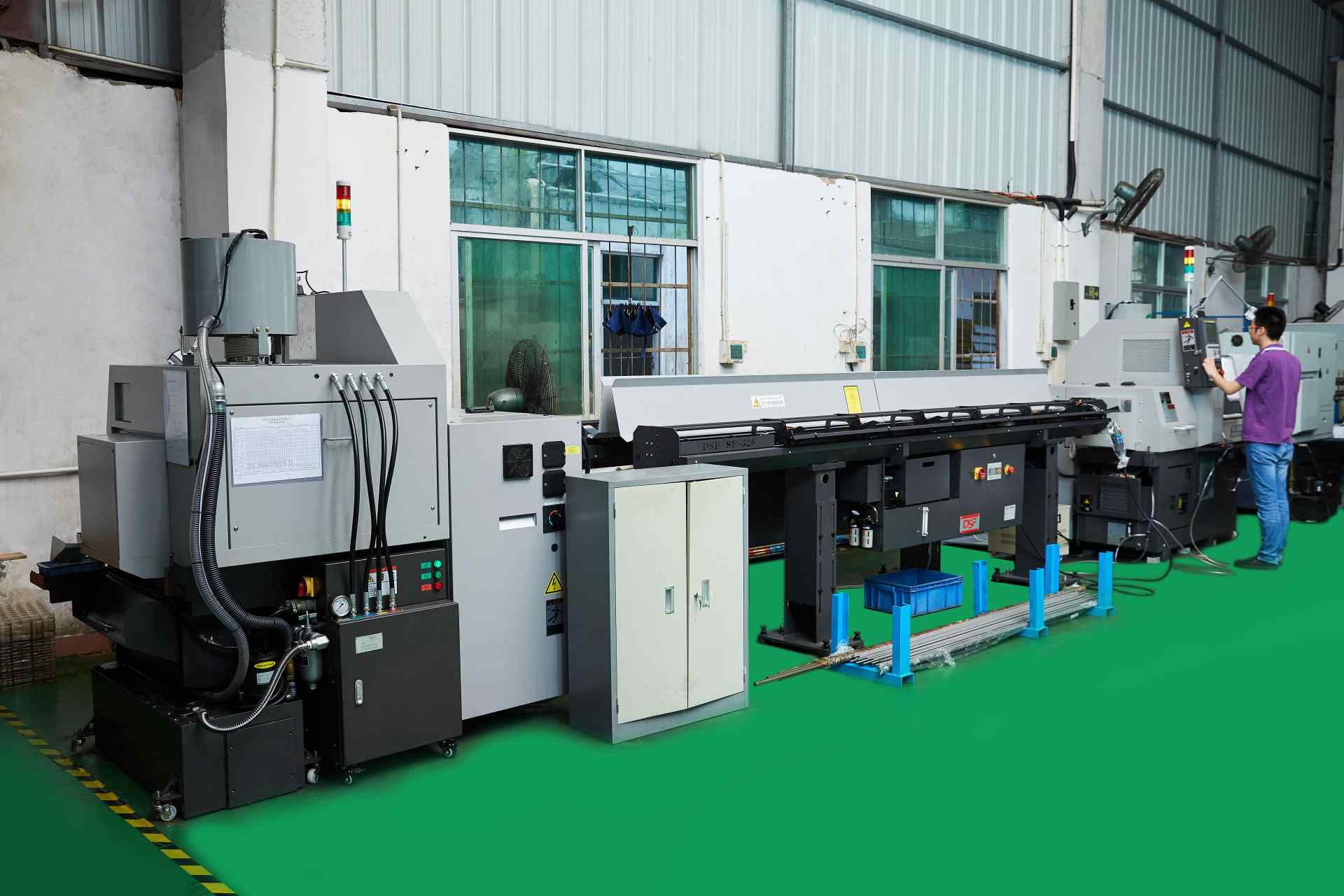
If you ask for capability evidence, you deserve a specific answer. This facility operates 100+ CNC machines across 6,800 m2 in Dongguan, China, staffed by 100+ people. The machines, listed by category:
- 5-axis machining centres (10+) - Mazak VARIAXIS I-600 (510/910/510 mm travel, 12,000 rpm, 22 kW, 71.6 N·m, 30-tool BT40) and Mazak INTEGREX I-250H S (B-axis 0.0001°, 24 kW, 124 N·m, 38-tool HSK-A63). Used on compound-angle parts, single-setup multi-face prismatic work, and aerospace fittings where datum transfer loss is unacceptable.
- 3-axis / 4-axis machining centres (50+) - Brother SPEEDIO S500Z2N / S700Z2N (10,000 rpm, 14/21-tool ATC, 0.7 s tool-to-tool, Z-axis 2.2 G) and Mazak VCE-430A L / VCE-570C L (10,000 rpm, 118 N·m, 24-tool ATC). Used on prismatic parts, plates, brackets, housings.
- Swiss-type turning centres (10+) - Citizen Cincom A20-3F7 (Φ20 mm, 10,000 rpm), TSUGAMI B0206-III / B0205-III (Φ20 mm, 0.1 µm), STAR SR-32JII / SR-32J Type N (Φ32 mm, 8,000 rpm). Used on long, slender rotational parts at ±0.002 mm.
- CNC turning centres (20+) - HEADMAN T70M/1250 (720 mm swing, 117 mm bore, 3,000 rpm, BMT75 12-station turret). Used on shafts, bushings, flanges up to ±0.002 mm.
- Wire EDM (5+) - Sodick AQ535L (550/350/300 mm travel, ±20° taper, 800 kg workpiece). Used on hardened tool steel, internal splines, sharp internal corners that milling cannot reach.
- Inspection: Hexagon CMM + 20+ gauges - Hexagon CMM for coordinate measurement, plus vision system, profilometer, hardness tester, coating thickness gauge, XRF for material verification. The 10:1 rule (gauge 10x more accurate than the band) is applied to every feature.
- Machine highlights - VARIAXIS I-600: one-setup multi-face 5-axis + MAZA-CHECK auto-calibration; INTEGREX I-250H S: DONE-IN-ONE mill-turn, B-axis 0.0001° + Ai thermal shield; SPEEDIO S500Z2N / S700Z2N: Z-axis 2.2 G + 0.7 s ATC; Swiss-type: guide-bush switchable + 0.1 µm resolution.
Tolerance bands: ±0.003 mm milled, ±0.002 mm turned, ±0.002 mm ground or wire-cut. Capability indices: Ppk >= 1.67 at the initial study; Cpk >= 1.33 ongoing in production.
Certifications: ISO 9001:2015 (116024/A/0001/UK/En) · IATF 16949:2016 (131941/A/0001/SM/En, design clause 8.3 excluded) · ISO 14001:2015 (116024/B/0001/UK/En), held by Dongguan Zhuohang Ltd (USCC 91441900MA4UWT6X39, since 2005).
Service area: we supply Austria, Belgium, the Czech Republic, Denmark, France, Germany, Greece, Hungary, Ireland, Italy, the Netherlands, Spain, Sweden and the United Kingdom in Europe; Brazil, Canada, Mexico and the United States in the Americas; China, Israel, Japan, Singapore and Sri Lanka in Asia; Australia and New Zealand in Oceania; and South Africa in Africa, with worldwide delivery from China.
Contact: Felipe Iglesias, [email protected], +86 13126536955.
Ready to machine your parts?
Send your drawing to [email protected] or call +86 13126536955 for a quote.
Frequently Asked Questions

What is your minimum order quantity?
The MOQ is 1 piece. Prototype and single-part orders are accepted alongside production runs, so you can validate a design before committing to volume and only then let setup cost amortize across a larger batch.
What tolerances can you hold?
±0.003 mm on CNC milling, ±0.002 mm on CNC turning, and ±0.002 mm for precision grinding. Critical dimensions are verified on Hexagon CMMs, with process capability Ppk ≥ 1.67 at the initial study on key characteristics and ≥ 1.33 on general characteristics.
Which metals do you machine?
Aluminum, stainless steel, carbon and alloy steel, brass, copper, titanium, magnesium, and engineering plastics including ABS, POM, nylon, PTFE, and PEEK. Incoming lots are XRF-checked against the mill certificate.
What are your typical lead times?
Roughly 3, 7, or 30 days depending on part complexity and process steps. Simpler parts ship in about 3 days; parts with surface finishing fall into the longer 30-day tier.
Are you certified?
In short, Yes — ISO 9001:2015, IATF 16949:2016, and ISO 14001:2015, with certificate numbers 116024/A/0001/UK/En, 131941/A/0001/SM/En, and 116024/B/0001/UK/En. IATF 16949 scope excludes product design under Clause 8.3, so this is a build-to-print manufacturer.
Do you provide material certificates and inspection reports?
Yes. Incoming material is verified by XRF against the mill certificate, and CMM inspection reports plus SPC charts ship with your parts, giving you documented evidence of what you received.
How is the price of a machined part built?
A part price has four layers: material, machine time, setup and programming, and finishing. A breakdown that names each layer tells you whether the price is honest, while a single bottom-line number hides which layer is heavy.
Continue reading: Machining Services Manufacturer · Manufacturer Machining Services · Machining Services
Standards referenced on this page
- ASTM B211/B211M-19 — Standard Specification for Aluminum-Alloy Rolled or Cold Finished Bar, Rod, and Wire
- ASTM A276/A276M-17 — Standard Specification for Stainless Steel Bars and Shapes
- ISO 9001 — Quality management systems — Requirements